Why have spiritual traditions treated sound as more than entertainment? A practical exploration of resonance, sacred sound and the ancient intuition that reality has a harmonic dimension.
The ancient intuition: reality has rhythm
Human beings have always lived inside rhythm. Heartbeat, breath, footsteps, seasons, speech and music all unfold through patterned movement. Long before modern acoustics, philosophers and spiritual traditions noticed that sound seemed to reveal something fundamental about order itself.
The ancient Greek idea often called the “music of the spheres” imagined the cosmos as a kind of mathematical harmony. In Indian traditions, sacred syllables and mantra became tools for concentration and devotion. In temples, monasteries and ceremonial spaces around the world, chanting, bells, drums and repeated prayer have been used to shape attention and create a shared field of experience.
Those traditions differ greatly from one another, but they share an intriguing intuition: sound can change the way a human being experiences consciousness.
What is resonance?
In physical terms, resonance describes a system responding strongly when it is driven near one of its natural frequencies. A familiar example is a musical instrument: a vibrating string can set another compatible string into motion.
Spiritual language often extends the word beyond physics. People speak of an idea “resonating” when it feels deeply congruent, or of a room carrying a certain atmosphere after music, prayer or ceremony. Those uses are metaphorical, but they point toward something experientially recognizable: pattern affects attention, emotion and perception.
Why repetition matters
Mantra, chant and repetitive prayer are powerful partly because repetition narrows the field of attention. Instead of constantly chasing new stimuli, the mind is given one sound, phrase or rhythm to return to.
That can create a transition from discursive thinking into a quieter, more embodied mode of awareness. Breath slows. Attention becomes less scattered. The practitioner begins to listen rather than merely produce sound.
A simple sacred-sound practice
You do not need elaborate equipment to explore the effect of sound on attention. Try a five-minute practice:
- Sit comfortably and take several slow breaths.
- Choose one gentle tone, hum or sacred syllable that feels natural to you.
- Sound it on the exhale without forcing volume.
- After each tone, listen closely to the silence that follows.
- Notice changes in breath, body tension, mental pace and emotional tone.
The goal is not to manufacture a mystical experience. The goal is to become more sensitive to the relationship between vibration, attention and inner state.
Sound, spirituality and discernment
Claims about frequency can range from established acoustics to symbolic spirituality to highly speculative metaphysics. Those categories should not be confused. A useful approach is to remain open to experience while being precise about what kind of claim is being made.
We know sound waves have measurable physical properties. We also know music, rhythm and vocalization can strongly affect human experience. Broader claims about consciousness, subtle anatomy or ancient sound technologies belong to spiritual, esoteric or speculative frameworks and should be approached as such.
The deeper question behind The Sound of the Spheres
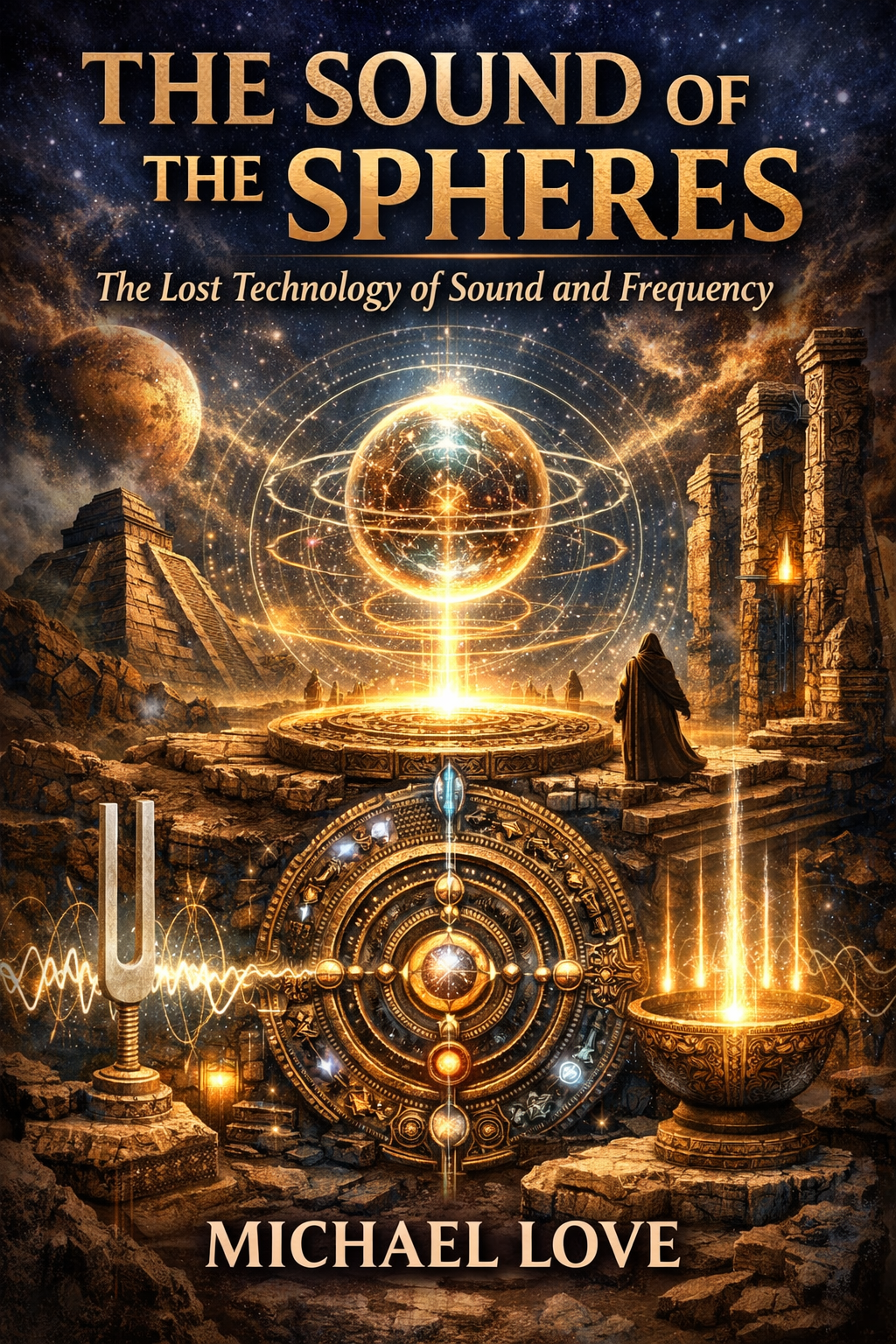
Michael Love’s The Sound of the Spheres explores a much larger possibility: that sacred sound may be part of a forgotten spiritual technology linking vibration, consciousness, ancient traditions and human transformation.
The book moves through harmonic cosmology, mystery teachings, spiritual anatomy and metaphysical ideas about suppression and restoration. Its central invitation is not simply to collect unusual theories, but to reconsider how deeply sound may participate in the way human beings organize attention, meaning and spiritual practice.
Enter the full journey through sacred sound, resonance, ancient mystery and the harmonic universe.
Listen more deeply
Modern life is saturated with sound, but that does not mean we are listening. Much of what reaches us is background stimulation: alerts, traffic, media, conversation and constant digital noise.
Sacred sound begins with a different posture. Attention becomes deliberate. Silence becomes part of the practice. The voice becomes something to inhabit rather than merely use.
Whether approached through spirituality, meditation, music or simple curiosity, deeper listening can become a form of inner alignment. Sometimes the first step toward greater coherence is not adding another idea. It is becoming quiet enough to hear what is already present.